
How to Sell to a Business: Expert Advice from Brent Meredith (Card #34)
Key takeaways
- Find the person who feels the most pain around the problem your product solves.
- Track every contact in a CRM or document so your team keeps the context as you grow.
- Identify key decision-makers and win an internal champion who can help you navigate the company.
- Expect most customers to start small, with a pilot or proof of concept.
- Give each meeting a clear objective, and follow up within 24 hours with thanks, a summary, and action items.
- Know what your competition is selling to your target customer.
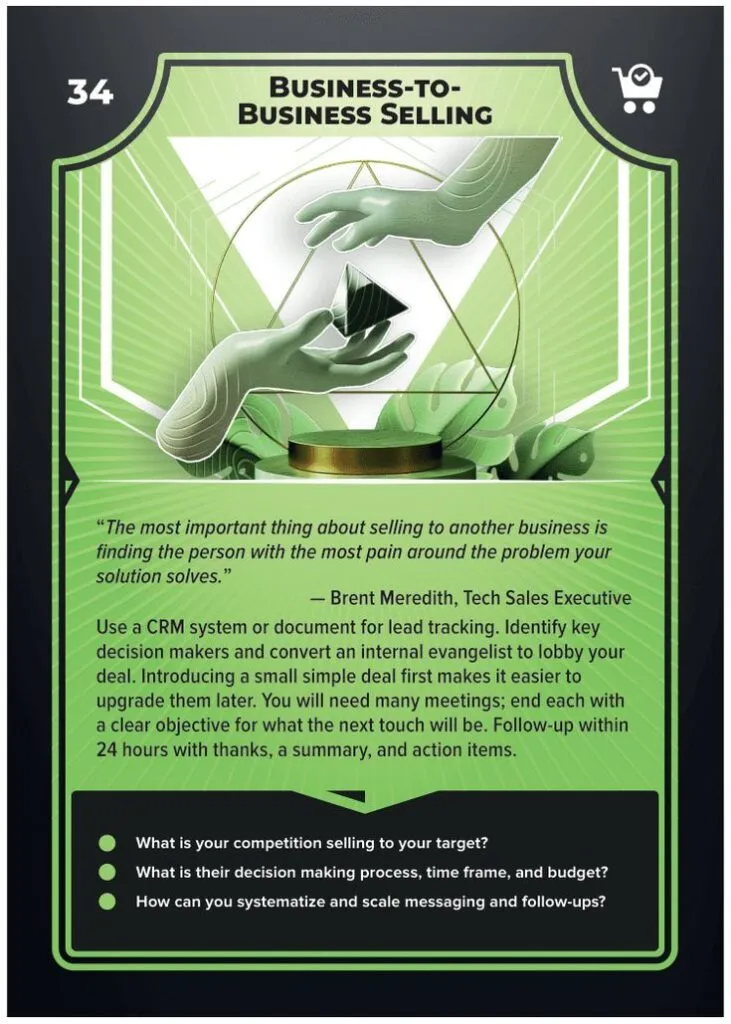
This guide goes deeper on card #34, Business-to-Business Selling.
John: Hey guys, welcome to success cards. And today. We’re with Brent Meredith top covering topic number 34 business to business selling.
Brent Meredith is someone who’s a good friend of mine and also an investor in one of my other companies Gametree Brent is a very very successful business-to-business salesperson. So I actually asked him if you’d be the one by the quote that we put on the card. Brent, Thanks for joining us.
Brent: Thanks for having me, John.
John: So, your last company you’re with was amplitude which game trees a customer of and you are the top salespersons. I understand and it rose to be a unicorn company very quickly.
And now you’re at sneak where I believe you said you were just in your first year the top sales-person east coast. And that again has gone to become a would you say eight and a half-billion-dollar company within six years?
Brent: That’s correct
John: So, guys, Brent, thanks to him is coming to share with you guys some information on the business-to-business selling to supplement the information in the cards. So Brent you had said that the most important thing about selling to another business is finding the person with the most pain around the problem Your solution solves.
Will you talk a little bit more around that?
Brent: Yeah, absolutely. So when you’re trying to sell into any sort of business whether it’s 12 people or 10,000 people or more you ideally want to find someone in that organization that would use your product and if you’re selling a product that’s a competitor for another product you would imagine that you’re the person you’re trying to sell to all might be using one of those products and what you want to identify is if they have any sort of pain that product at all. You want to tell them what you do but then start asking questions about how they do things. Right? And if you already know how your product is different or better you can interject that right to this new person you’ve met. And by doing that you’re able to, you know, catch their interest. Because people don’t care to talk to don’t care unless you can solve a problem they have. There are some instances where they don’t know they have a problem which you’re probably selling a very Innovative product in which case you’ll need to get them, you know hooked a little bit differently. You need to demonstrate the value a little bit more quickly. And you can kind of Imagine.
Let’s just take a lumberjack for example, and he’s you know, he’s in the 1800s and he’s using an ax to chop down a tree and I walk up to them and I say hey I’m selling chainsaws. This will chop down the tree and you know, 10 minutes versus how long it takes you to chop down that tree two hours three hours four hours, and he’s gonna look at that chain size back. No, I don’t need that doesn’t I can’t sign that thing and then I’m gonna be: hold on. I’m gonna pull the chain and show them how it works and then he’s like, oh now I do have pain so finding that pain is very very important.
John: Very interesting. It says sounds like identifying pain and also taking a broader View and like you said Imagining the competition.
And I’d like to dive into also, how do you find out who these people are that have the pain point and actually get in touch with them?
Brent: Yeah, so the first part about identifying the person you’re selling to is understanding who buys your product typically so it’s gonna take some trial and error and you need to reach out to a lot of people in the tech world that I work in, you know, we do a lot of our prospecting on LinkedIn. We’ll search through Linkedin you can upgrade your LinkedIn to business accounts, which gives you more filtering options. It doesn’t cost a lot and it’s a good investment. I’ll be able to see kind of who’s who on LinkedIn you don’t know so I need to pay for back strongly but it helps then you can you know, add those people or send them messages whatever you like. And then from there as you kind of start to book meetings that way then you’ll start to narrow it down to what your target market is, you know start to see patterns around the type of persona that tends to pay attention to your products and messaging.
John: diving into the card now, so I wrote here to use a CRM customer relationship management system or document for tracking. What do you think about this? Will you elaborate on it?
Brent: Yeah, so if you’re the business owner and you’re starting with a small business or you’re you know, a large business up and running you need some way to keep track of your customers who they are, and their contact information interactions you’ve had with them and especially if they’re spending money with you you want to keep track of that so crms are an acronym for customer relationship management. You may have heard of companies like Salesforce or an up-and-comer called Braze, there are tons and tons of messaging systems out there that can integrate with these crms as well. So you can automate messaging through them in a marketing capacity.
But essentially what they’ll do is you will input their information manually or you can upload it in some cases to find where you’re keeping the data now and it will store it there. But especially as your business grows, you want to you’re gonna need to think about the people that are gonna be kind of coming in and helping you run this business in the future and they need a context of what’s happening with that person or that I account if you will so generally in a CRM if you’re doing B2B sales, you’ll have you know different accounts. Those are the companies you’re trying to sell to and then you’ll have different people associated with them in that account.
John: I find these are also useful in keeping track of your network even just as an entrepreneur or CEO or any business person just to keep kind of keep notes on people over the years because you never know when they’re going to come back in handy or something might remind you about them. And if you don’t keep un information logged then a lot of times it disappears.
Brent: Yeah, that’s your little black book. Yeah,
John: so, another point is to identify key decision-makers and convert an internal evangelist to Lobby your deal. I guess we covered that a bit but a question that pops out of that is.
How do you actually figure out the internal structure of the company? Who actually is the one that has the pain Point?
Brent: Yeah, it ties back to the first question right around how do you know sell something the first place you have to find the person that has pain or the group of people that have pain and then generally, you know businesses don’t make decisions on their own you reach out to someone and they say they want it. That doesn’t mean they’re gonna buy you’re gonna have to build that person up and get them Involving your product and interested enough to bring their colleagues into the place because the chances of you getting a hold of the decision-maker who actually has a budget depending on what you’re selling is pretty slim to me. I sold really big companies it almost never happens. I’m always dealing with someone lower and building my layout.
Right and that person we call that person the lingo for it and sales is your champion this person that is you know, your right-hand person at that company that is helping you figure out to navigate the company the structure how they buy how they try different things in my case try different software. And if you don’t have someone like that, it’s very hard to get it done unless that company has an active project evaluating products like yours, and then you’re involved in that evaluation.
John: Next up is introducing a small simple deal first makes it easier to upgrade them later. What do you think about this?
Brent: Yeah, so, you know, I’ve been selling for a very very long time and 99% of the deals that I do are relatively smaller deployments in comparison to what the company could grow into most companies will not for all their money at you for all the product all at once. They’re gonna buy a small portion of testing or they’ll call it a pilot or a proof of concept and they’ll buy a smaller amount. They do this to protect themselves. They don’t want to spend too much money on something in case it doesn’t pan out but kind of pull themselves back and try not to think about like, oh, you know I could do this bigger deal. If you can get the smaller deal faster 99% of the time you should take it. Because a burden in the hand it’s better than two in the bush if you will and there’s a there’s also phrase a common saying in sales called time goes all deals. So if you want to get things done as quickly as possible. Even if you can kind of see a larger deal down the line it just by taking a lot longer to take the smaller deal builds the relationship with the customer. To help them get value from the product and if they get value from the product, they’re going to buy more.
John: Great advice, so don’t be too greedy and don’t overwhelm them or try to sell something bigger. It’s better to just something small and uses that as bait for something bigger. Brent: Exactly.
John: All right. Next up is you will need many meetings and each with a clear objective for what the next touch point will be follow up within 24 hours of thanks a summary and action items.
Brent: Yeah, so the customer experience is really important. You’re gonna go into these meetings and the people you may have never met you just reached out to my LinkedIn or email you called them. And you need to immediately create reports. So you need to go into this call with some idea of what you want to accomplish. because the person on the other end of the line might not know what they’re there for or they might have taken the college to see what’s up. They have no idea what they’re getting themselves into so you want to set the agenda and upfront you want to say hey today, you know, I want to ask you a few questions about how you’re doing things today. And then I want to talk about our products. So definitely ask a few questions on how they do things relating to your product today upfront. Don’t spend too much time on it, but see if you can get a little bit of pain out. And then you go into your presentation or your talk or whatever it is. That’s the meat of the meeting.
And as you go through your slides don’t just kind of talk don’t just read through them and don’t ask them to gauge. You want to say, you know at certain sticky points you want to say, what are your thoughts on this? Don’t say what do you think? So what are your thoughts? It just lands better and it gets more responses by asking a special.
John What do you think is a judgment. But what are your thoughts? is like an open-ended question.
Brent: Yes, and if you ask them throughout the meeting instead of all upfront you’re starting to pull different pain points out and you’re trying to understand their business better. And so by the end of the meeting, you have your kill shot, right? So for example, I was on a call yesterday with a company that has a very immature security program.
And he was starting listening to competitors. And you know, I knew one of them was a larger competitor that’s been around for a long time and they but I know that you know, the product isn’t quite as Innovative as good that’s you know, why my company the workout sneak is growing so quickly. But he also mentioned a couple of competitors that I know could cause me trouble which is smaller companies.
So since he has a new since I found out during that call that he has a new program that he’s starting out. He needs help. I offered something called Professional Services and I said, you know sleep in your big enough company to have Professional Services these people and these teams will come in and help you build out this program. This company can’t help you do that. This company can’t help you do that knowing full well that I was gonna be able to disqualify in his mind out the smaller companies and leave me up against the larger competitor that I know I can be Because we’re more Innovative product and you know, I kind of slimmed down my competition by doing that.
John: So, on that note going into the prompts on the card asking yourself the questions to really challenge yourself to think about these things and then getting your input on this the first one is what is your competition selling to your target? What do you think about this? Why is it important?
Brent: So, if you’re still in a product and you don’t know what else is out there, then you will see me ignorant. You will need to be kind of an expert in your field and what your product does so we’ll go back to as the chainsaw acts, you know scenario if you’re going into that scenario and you’re still on the chainsaw. You need to know how to un axe works. You need to know why the axis and efficient. You should know how long it takes someone on average to chop down a tree so that you can say Hey, you know, if your team uses these chainsaws you’ll be able to cut down five times as many trees in the same amount of time and you’re rubbing an older, you know.
yeah, so it’s very important to understand your competition and be able to talk to it because if you can’t. if you’re going in line, then you know, you don’t know what you’re gonna bump into you might get lucky and you might not
John: next question is what is their decision-making process time frame and budget?
Brent: So, this is a tougher one to get to and it usually bumps into the later and of the larger deal cycle. So if your product is, you know selling to large businesses, you know, anyone any kind of company over like a hundred or fifty people and have some kind of decision process and who you’re selling to and likely if you’re selling from the company you’re selling to it’ll be like a VP or a CRO or CFO or maybe signing off on it, but If you’re especially, you know, trying to forecast your revenue for investors, or you want IPO, it’s very important for your sales team to understand. And what time frame do they think that deal could possibly come in and sign. So, you need to understand, you know, what’s their process do they need to try the product or they can they just, you know, can they just sign up and pay for it? Do they have to go through legal review to use your products are there security concerns around using your product? That’s more applicable to software usually. And then how long does the actual signing process take? you might have someone sell you like Hey, but the old is done. We’re ready to sign it. But the signing process at a 10,000-person company is sometimes seven people and can take a week or two.
So understanding, all those things will help you.
Not only with your sanity. But also if you’re really aggressive growth goals and your forecasting to investors, this will help a lot.
John: Hmm and the last question here is how can you systematize and scale messaging and follow-ups?
Brent: Yeah, so there’s a variety of tools that can help you do this. I mean, even Google Calendar and Gmail, I think a reminder setting them but there are tools like outreach.io. There are companies like Braves, and many others that can help you do sales marketing at scale which means you know, a salesperson can automate a series of emails that go out to the Prospect and they’re very very helpful and you know. It’s the found how many people you’re talking to these sorts of tools become really necessary because you will forget to follow up with somebody.
John: There are also tools like hunter.io that can pull out email addresses associated with the web domain. Do you use those as well?
Brent: hunter.io, Zoom dot Zoom info is probably the largest one in my field for collecting email addresses and phone numbers. There’s another one called Lusha and yeah, you know. You find the people on LinkedIn or however, you’re gonna find them and then these other tools will help you get their contact information like email addresses and phone numbers, and in some cases, you might just be able to buy a Zoom info license and you can just go in there and find people. Because they have tools to help you map out an organization too. Just LinkedIn is usually more up-to-date than their data actually.
John: Well that covers the card. Thank you so much ben. Do you have any other topics that we haven’t discussed yet that you think are important tactics strategies actionable items that are important to know but may be less common knowledge either intuitively or based on the common literature that people otherwise find out there.
Brent: Yeah, I think sales when you’re selling in general some salespeople can be overly aggressive and kind of not helpful, and my mantras always to give the people. I’m talking to the best customer experience possible, which means you know, I talk to them on the phone. I talk to them calls I get them with me, but I’m I go out of my way to make sure that I’m getting them what they need and being very transparent about it and you know a lot of times I mean detailed follow-up emails, Introducing them to you know people at my company that they need to meet to make a better decision for themselves offering customer references. So they can talk to other happy customers offering whatever I can to help them make the decision easier
John: How important are case studies or being able to reference similar clients.
Brent: It depends. In my experience, they don’t help as much as you might think. They certainly create validation, but one of the worst things the sales first you can go into is saying oh: hey like we sell to this company, you’re just like them, you probably have the same problems because they don’t. They do things differently. They are operating different you know. You could read the company’s entire formal and okay and still know nothing about how they would buy or use your product. So it’s better to meet someone talks to them, and get that information on yourself so that you don’t kind of Because I can also come across as rude.
John: The last question. I would like to ask you to follow up. What do you think about relationships and the selling process?
Brent: I think they’re very important. Just depends on what you’re selling. If you’re selling, you know, heavily commoditized products, you know, like cloud storage like Amazon Google Cloud relationships are very-very important, because the products are not that
different, so these guys are out there making a ton of money but they’re also on the road a lot. They’re taking these guys up golfing. They’re going to bars and take not to dinner. No, whatever they can to earn that person’s business and trust and build friendships with these people. That’s not always the case, you know, relationships don’t sometimes people aren’t interested in a relationship. They’re interested in: well this product helps me and a lot of times, you know, that sales process is exactly I just described is getting them all the information. They need to make the best decision. But relationships and then liking you does always matter. So, if you want to whether it’s on Zoom or in person you want to seem like a ball if you can get in front of in person, you should probably do it. Covid, you know, throw a whole mess in that, but people are starting to go back to in-person meetings. And I mean a lot of them like business conferences, like people going around like it’s back to business as usual in a lot of cases.
John: Alright, guys, you heard it start selling. Brent, thank you so-so much for sharing all this wisdom with us. Okay. For an audience, this will also be available as a YouTube video of a podcast and a blog post in case you’d ever like to subscribe to those platforms. If it’s even more convenient if you have any more questions on this topic, or I’d like to share any stories or tactics, please post those in the comments, and I and also Brent will take a look down the road and also be able to give you some responses.
Brent, thank you so much again for being with us.
Brent: Here. Thanks, John