
How to Systematize a Business: Expert Interview with Sam Carpenter (Card #82)
Key takeaways
- See your business and your life as a collection of separate systems.
- Isolate the system causing the problem, then fix, delegate, automate, or eliminate it.
- Ask what you are doing that someone else could do, what you are best at, and where your time is most effective.
- Have the frontline people who run a system help create it.
- Without active management, your systems run on their own and life becomes chaotic.
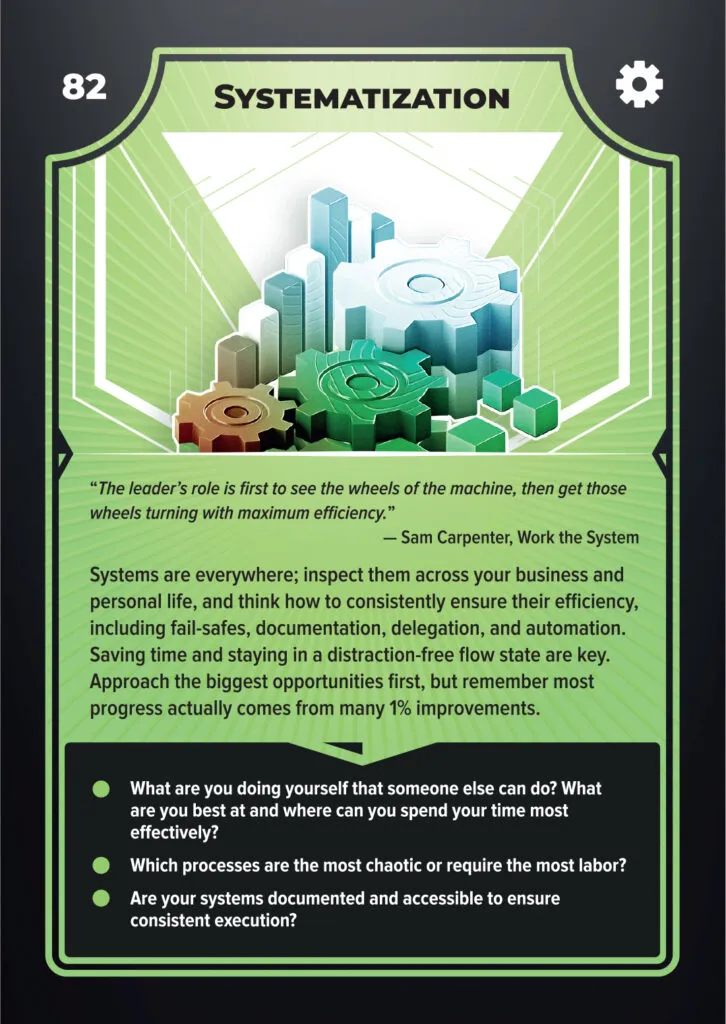
This guide goes deeper on card #82, Systematization.
How to Systematize A Business? Expert Interview with Sam Carpenter. Card #82
 John: Welcome back to the success cards podcast. Today we are joined by Sam Carpenter, he is kind of a hero of mine. He actually wrote a book called Work the System that was given to me as a gift by a friend on how to systematize your businesses and that was the biggest inspiration for creating card Number 82 systematization his messages largely about being able to see your life in your business as a system and being able to automate and improve and essentially getting it running and oiled so well that your business almost runs itself effectively in reliable ways and it gives you a lot of freedom. He also has a few projects and companies the biggest of which is Central Tel which is a call center so if you’re ever outsourcing calling which is part of systemization then his company does that very reliably and very well. Um, Sam, thank you for joining us.
Sam: It’s great to be here John, thanks for the invitation.
John: So I actually, first off applied uh some of your wisdom that’s the most apparent is something I do every day is check my email and my company GameTree, I actually had it so I was just checking one of the shared emails because maybe 10 to 20% of the emails are relevant to me and upon reading your book, one of the first things I did was delegate that so somebody else is checking the email exclusively and I just took myself off of it and then they just let me know every once in a while when I have that thing that needs my attention and then now in another company, I’m doing the same thing so this is an example of the kinds of savings you get with systemization. You don’t have to divide your attention so much or waste your time as much so those are some benefits I really got from his book with the system. So Sam, let’s start with your quote; “The leader’s role is first to see the wheels of the machine, then get those wheels turning with maximum efficiency” This is something I love, do you have anything to say about that or elaborate on it so that the people with this card back home can have a deeper dive before applying your wisdom to their own businesses.
Sam: So let me uh, further define your description your initial description, actually our lives are a collection of systems one of which may be your business which is a collection of subsystems and so this isn’t, this is about efficiency but I don’t go about it the way most system gurus go about it and I wrote the book, this is a fourth edition, just came out, the fourth edition of the book I wrote it back in 2008 and ih there’s a lot of system gurus out there and it’s always about efficiency and getting more done and it is about that it certainly is about that but I started a very mechanical place and worked toward a spiritual place. Now, when you understand how beautiful this world lays out and the systems that are in it, you’re a system John, I’m a system, my two dogs that you can’t see, in my two hounds beautiful that’s sleeping, and uh their systems too. The idea is to take a business, see it as a system but break it down into its subsystems. So yeah getting your emails uh delegated is great and the mantra is “automate, delegate, delete.” The first part of the three-part book works the system is uh to get what we call the Systems Mindset which is the title of my second book. This is the, this is a business book, this is for everybody who doesn’t own a business, it’s smaller. It’s called the systems mindset, my publisher hated this cover that I don’t know. It was published in 2016.
John: Oh, I somehow missed that book but that was interesting but yeah.
Sam: It’s the same, it’s the same philosophy if you want to call it that, the same approach it just doesn’t have all the business documentation stuff in it but the whole thing is to see your life as a mechanical apparatus, which it is if you go a layer deeper and you have to get your mechanical straightened out before you can get to the spiritual part. Now the spiritual part for me is, I live in Kentucky, we have a beautiful home here it’s not huge, it’s three thousand feet uh we own it outright, we don’t have any bills, I have a beautiful wife, who I believe loves me. Last time I checked this morning, I have these two beautiful dogs uh, I work maybe three or four hours a month for the call center because I’ve automated, delegated, deleted, and I have a 30% bottom line, my income is way more than what we need so I’m living the life of my dreams because I paid attention to the mechanical aspects, you cannot get to the spiritual part without getting mechanical world straightened out it just drags you back in the mechanical keeps trying you got to make the rent you gotta pay the car, the car payment so my approach is very spiritual in the sense that I acknowledge that there uh, we live in a mechanical world and it is very inefficient for most people they are not getting from A to B in a straight line. For instance, A and B is the wrong place to go to, but this is about defining where you want to go, and there’s documentation involved going from A to B in the straightest line possible and as quickly as possible, and now I get back to your quote, on your success card, and so that kind of what it’s about, but the whole part one of the book is to get the systems mindset where as I rattled off the different systems that I can see right now and I think about the lights, when you can see that on a moment-to-moment basis, it’s a it’s an it’s a mini enlightenment, it’s an enlightenment and it happened to me in 1999.
John: I love that.
Sam: Exact moment it’s all in the book, uh my life has never been the change, it’s never been the same and I’m living the life of my dreams and I’m happy every minute? No. It doesn’t guarantee happiness 100-percent of the time but it makes it a whole lot easier to be happy when you have more money than you need and more time than you need.
John: The seriousness to make you unhappy.
Sam: Yeah and if you can live a creative life as I told you before we started to talk, I spent, you know, a little bit of time on Central Tel, I spent a lot of time writing, doing podcasts, doing interviews, media TV, I, I love doing that. I love talking about this stuff as you can tell. I’ve been doing it for 14 years now and uh Central Tel, my main business which is doing so great, I’ve had for 38 years. I still have it today. So uh, get the mechanical parts straightened out first and that’s when you talked about your emails. Yeah, that’s a good start and once you get a grip on fixing this system and then this system and then this system, and you have the systems mindset the sky’s the limit.
John: So glad you refer to it that way because so much of education and coaching is really about a mindset, it’s almost like being in a mood or almost on a drug, where you suddenly, reality becomes different at Babson, an entrepreneurship university that attended the main thing that they really teach is having like an entrepreneurial owner’s mindset where once you start flipping from seeing the world as you’re kind of in it to like you own it and it’s about like profitability and how to kind of maximized these certain metrics, it changes how you can function whether it’s like within a job at somebody else’s company or running on company or just seeing opportunity everywhere all the time. It’s really just a mindset change.
Sam: So, well yeah, and that’s fine, that’s a philosophy and Tony Robbins has a philosophy and everybody out there has a philosophy and this goes even a layer deeper than those philosophies, you can stick with those philosophies and those approaches but this goes a layer.
John: This is a metaphilosophy it applies across other kinds of domains not even just businesses you’re saying.
Sam: You can keep your religion, you can keep your politics, you can do whatever you want to do just goes a layer deeper and when you can see how things, if you can see reality a little deeper, you’re going to have more success, but if you’re playing a game and you’re what you want, is not what you can have or you know if you’re playing these super positive, I just have a positive attitude, I said, no there’s, it’s got to be, you have to have a good grasp of reality and 99 of 100 people don’t you need to go to where you can see a layer be what I always say a layer deeper of how the mechanical pieces fit together then decide where you want to go decide how you’re going to get there and it takes a little bit of work it takes a little bit of documentation but that systems mindset does happen in your head.
John: It’s that people not doing systematization are basically running on a hamster wheel and until they kind of solve this one part it’s hard to get different results than they’ve been getting in the past that’s somebody’s happy with where they’re at then they don’t need any changes, but if you can systematize things to make them more efficient and easier then that enables that
Sam: That same energy to go somewhere else in life. Exactly if you can, if you can see the world a little clearer than the next person and that’s, that’s what’s done it for me is I’m able to I’m able to grasp the pieces out there a little better than the average person and so I was able to assemble those pieces in the right sequence in a straight line to get where I wanted to go here and here I am. I don’t need to work, I’m doing this for fun and because I, I’ve gone back and forth with you John and I love your success cards, those are terrific.
John: Uh, so, let’s get some pointers for the listeners on how they systematize their lives. What does this actually look like and how can they apply it to the businesses, so the first part of this card is saying “systems are everywhere, inspect them across your business and personal life and think how to consistently ensure their efficiency including fail safe, documentation delegation, and automation.” What do you have to say about that?
Sam: Well, I kind of, I kind of said it in a roundabout way already but until you can see the systems in your business or your personal life, until you can see those as separate from each other, this is critical, and I know we all want to be one and we’re all connected I get that but in the mechanical world, if you want to get into the spiritual thing, you’ve got to acknowledge that your kidney has nothing to do with your lungs, not really you fall off your bicycle and break your leg, you’re not going to be rushed to a dermatologist, they’re separate this is key to the systems mindset your life is a collection of separate independent systems in until you can see that separateness, you won’t be able to bring a whole thing back together. Otherwise, you got what I call and this is a term I’ve used for many many years, a chaotic mass of sight sounds and events all swirling around and how do you get a grip on that? But what if you could take the most dysfunctional thing in your life and isolate it and fix it, or eliminate it, or automate it, or delegate it, and then what if you took the next biggest problem. Let me give you a kind of a fun idea here so I use this analogy a lot so we consult a business and it’s a guy’s got 20 people in his business, he makes 2 million a year, he makes some product, okay that needs to be sold. Make the prodigal you need to have a market, well his sales manager is his brother-in-law and he’s lazy. Okay? So we go in and we say look, you have a problem with sales and the problem is your sales manager, you’ve already told me that, you’ve done talking to the owner of the company you’re you and you don’t know what to do about it because you’re afraid your wife will leave you if you fire him. Well then keep doing what you’re doing but somehow use your imagination to get rid of this guy and get a real professional sales guy in there and you fix that sales dysfunction until you fix the biggest dysfunctions of your life and then you go to the next biggest problem, you isolate that you fix it and most people just swirl around from thing to think. You know they got the problem with the teenager, they got a problem with the job, they got the problem with the boss and they swirled around and around and around and maybe some of those things need to be fixed and he can’t do them all at once with a with a branch you they really are sequential and this is key everything happens over time, everything executes overtime and so I’m breaking a system loose from all the other systems you actually write down the steps in a system how do you answer the phone in your office? One we do this, two we do this, three there might be seven steps, we have a process that Central Tel, the call center is over a 100 steps to get it done. One process but we focus on that process and focus on that system and then we get that under control and then we go over and get this under control, pretty soon you don’t have any more problems, you don’t have more complaints, if you have a complaint, you jump on it and whatever it was, it might lead you to fixing a dysfunctional system all my managers do have about 60 people and I say about 10 of them are managers and all we do is work on perfecting systems, so we’ve got a huge bottom line. I have probably a third less people that I would need otherwise to do all the fire killing and you get super efficient at each system and I’ll finish by saying what is the biggest problem and you attack that first and it might be a very simple thing to fix our first problematic uh, back in 2000, actually 1999 our biggest problem we fixed in 8 hours of work over 3 hours over a 3-day period the next biggest problem took us several months but it was worth it, totally worth it, and I went from 100 a week, I spent a decade and a half John doing 100-hour work weeks and you know from the book, I went to 60, I went to 40 now here I am at two, maybe two hours a month and its highly profitable, I don’t have to be in the middle of it, we want to be out of the middle of the chaos and looking down on our business.
John: That’s such great stuff and I just want to emphasize the importance of systems not just say, I’m saying it but a lot of the best business leaders I know are people who are very systematic in their thinking and they build great systems to the point where they own a lot of companies or extremely large companies and at the end of the day, I view people and systems as the two main keys but the best people build the best system but a lot of the best systems are able to recruit and train the best system and if you look at a company as it scales, it’s the most effective systems that survive, it’s almost like some sort of evolution system where the, the companies that are able to spend less be more liable, do the result better it all comes down to just how well they can actually plan and identify and execute their system.
Sam: Yeah, and they’re working on their systems all the time and here’s the thing, people don’t pay attention that they don’t see clearly the individual systems of their lives are being dictated by the systems that are in their lives whether they like it or not, and it’s randomly, If you just randomly your systems are operating the best they can and you’re not managing them, then your life is going to be chaos. And so the idea is to manage the systems that are already in your life, add some new ones, get rid of the ones that are awful like whatever you need to do is the manage of all of them, see them but you can’t manage them until you see them and that’s what part one of my book is about is getting your head to the place where you see the separate systems in your life. That’s the key.
John: Yeah, and there’s really an audit in there to actually inspect things and break it down. The next part of the card though I think we’ve covered it is saving time and staying in a distraction free flow state or key approach the biggest opportunities first remember most progress actually comes from many 1% improvements. So yes, do the biggest things first but then if you make a 1% improvement today, you’re going to live many, many, many, many days it will pay back so many times regardless of the stage, so it is all about the system and all the best results come from just making lots of little tweaks, a lot of the time.
Sam: Exactly.
John: So the, the questions on the card, for people to apply to themselves are the first ones are, what are you doing yourself that someone else can do, what are you best at, and where can you spend your time most effectively?
Sam: Perfect example is what you said about delegating your email John then you can go ahead and incrementally get more time to work on systems because ultimately, you want to work on systems all day long. You don’t want to do the work. It’s really tough if you’re an artist or a professional baseball player or an athlete that makes the, I mean you have to perform. You are the system, you but for most people they’re running a business it might be any number of businesses that they can automate, delegate, and delete, over and over and over again pretty soon, you have the time to be even more creative and unleash maybe a new creative business. As I said, I make a great income with the call center that I’ve had all these years, and I hardly work. I mean isn’t that what everybody wants and you want to be creative. How you put those systems success system cards together was an awful lot of creative effort there and I would wager that was fun for you, it was a lot of work.
John: The first half was fun but these cards took a lot of work.
Sam: Yeah.
John: Yesh, but after a while it’s like okay, I can’t compromise the quality but there’s a lot of them.
Sam: A lot of work but what’s satisfaction now that they’re out there and you can sell them. Anyway, you sound like a creative guy. I’m a creative guy and I like to write we’re usually really good at what we love to do and this is what I love to do, not good at it.
John: Yeah, uh, some things from my own comment on the delegation is I study personality psychology quite a lot, like many thousands of hours just even published possibly the world’s first scientific personality test that was developed with scientific method. Something that I have learned from this is that people are essentially in a way similar to like bees or termites or ants, and that we have natural propensities to enjoy different things that we then become good at and we have different kinds of fears and essentially what it does is it creates division of labor, which in economics is a concept that’s proven to ultimately generate better results and so he’s almost involved this sort of division of labor naturally in tribes to ensure all of the work done by people who are like really enjoy those things and are really good at them and you get a better result than just everybody doing everything so somebody’s specialized as a hunter versus taking care of children versus building, you’re going to get better results than if one person just tries to be good at everything. And so, part of the systematization is understanding your own mind and trying to be very real with yourself and think like what are the parts that I am best with so you might realize that even systematization might be your fault and then you have to account for that, you have to find somebody who can help you systematize, I know that Sam offers consulting or maybe you bring in a friend or you know that you should put in disproportionate effort to this if it’s not something you naturally do because each of us is only an individual alone, we’re all crazy, but as a tribe, we’re a lot more well-rounded and get better results. So sometimes you have to look outside of ourselves to get the best results. Um, not necessarily designing the system 100% ourselves, getting an expert who knows the system really well, build it well.
Sam: That’s important uh you talk about a tribe so if somebody has a business with let’s say 60 employees like I have, that’s my tribe. Yeah, I paid them to do this but they all buy into the philosophy, right? And they all contribute and it’s very important uh, these systems need to be created by the people who execute them, the frontline people, the sales people, the production, they need to, they need to put them together actually or representative of a group of them. Uh, step one, step two, step three, and then they’re bought into them but you don’t want to be the one as the leader of the company doing the processes, the documentation, and everything. You want to be the one to approve them, you want to be the one to teach people how to do it. It’s all my book, that’s why my book is as a guideline but the tribe is the organization, maybe it’s a non-profit. Ok, but you get everybody to buy into it. You find people who want to buy into it and things get very efficient. People make a lot of money, people have a working environment, that’s not stressful. If, if you’re not killing fires all the time you and you’re just building your systems even more perfection. How great is that? I mean, that’s, that’s, and that’s what we teach. We’ve coached and consulted over 1000 businesses with our business arm and we never had a failure.
John: And like you said, your company, maybe it requires a third less people which isn’t like a hundred times less but at the end of the day, there’s a profit margin and if your costs are so much lower your profit margin is that much higher. That’s you know doubling or tripling the profit margin on what most companies’ numbers look like. And now we’re going into a recession so we’re heading towards the time when having efficient systems at the most important because you can’t afford to mess up and this is when a lot of companies go bankrupt and a lot of the best companies in future are going to be born on a historical cycle recessions actually create the best companies, a lot of the biggest ones that we know today are actually built in down markets because they have to be smart about how they build their systems and be efficient from the beginning that then allow them to scale into these very successful enterprises.
Sam: Yeah, and once, once you can see the individual systems, the rest of it takes care of itself. So you kind of intuitively know what to do about it, right? Well if I do this, it’ll affect that, if I do this, it’ll well maybe it will but if you can isolate the problematic system in the first place, it’s not a long road to getting it fixed, delegated, automated, or eliminated all together.
John: Gotta remember that mantra that the next part says which processes are the most chaotic or require the most labor, uh this part I think that we’ve already covered, but it’s good for the readers to apply and think about that. And the last bit is, are your systems documented and accessible to ensure they’re consistent execution. That part really stuck out to me because it is easy to design the system, but if it has problems then it stops working and a lot of people kind of think once they design it, they’ll be fine. So we share a little bit more about this.
Sam: It’s not enough to design the first perfect process and let’s talk if you have a business, let’s talk about answering the phone at the front desk. This person answers it this way because I think that’s the best. This one answers it this way, and you have like four people, let’s say who answer the phone the very best they can and they’re really good people so it must be perfect. No, it’s not perfect. What you do is you sit down with the four people and you all just have a round-robin and decide which is the best way to answer the phone. There’s a number of ways to answer the phone but one of those everybody will agree is the best. It takes a little bit from this person, a little bit from that person, they go to the boss, they say here’s the process for answering the phone. That’s just a microcosm of a system. There’s lots of systems throughout any business. The documentation is critical to give it substance. What if you take the very very best way of doing something and do it that way every single time, what do you think the results will be? If you lay it out over hundreds of processes across your business and you’re constantly updating those processes as times change and making them better and better and I go back to what I was saying about working on systems all day long. We have frontline people who answer the phones and take care of this, and take care of that, but my managers, the people who have clawed their way up the ladder into management position, are watching processes and making sure that processes are being executed properly and getting suggestions from the frontline about how to improve a process that’s all we do at my call center is that is all we do at the work the system organization, is make the processes better and better and better and better.
John: Yes, I kind of like to think through what do you do consistently or over time and it might not be everyday, it might be every like sporadically or every week but those are systems.
Sam: Exactly.
John: For example, in my company, I sometimes talk to investors and they always request certain information so instead of rewriting it every time it’s like how can I most quickly and easily process the service and it actually saves time in the long run.
Sam: Ofcourse.
John: So that covers the systematization card, um Sam, is there anything else that you want to share with us about how people can apply or think about this sort of information to improve their lives and their business.
Sam: Yeah, there’s a kind of an exercise, I’ll go through it very quickly and that is wherever you are, you are driving the car, listening to this, you’re at home watching whatever you’re doing, stop for a moment and look around and identify the individual systems around you. I can sit here and identify within 2 minutes probably 100 different systems that make up my life including parts of my body when you can sit wherever you are, in the house or in a car, or out in the backyard and readily identify the separate in the independent systems around you, you’re on your way. Maybe it may make you crazy at the beginning but you’ll see the beauty and the benefit of it. It’s not manipulation of your own head, it’s actual reality that your life is a collection of systems. What has my little hound, Pearl got to do with my coonhound over there, Justy, nothing they’re both hounds but they’re not connected, but they get together, they work together great. And so do that exercise wherever you are, after you watch or listen to this and you’ll start to get a feel for what the system’s mindset is. And, that’s what my writing in my philosophy is all about is going that one layer and deeper and seeing how the mechanical world is actually you can see more accurately how the mechanical world is put together.
John: That’s so great. Yeah, it’s really about applying the information that’s so much about what success cards is all about. It is actually doing the work. You can’t just tell somebody a mindset, you have to practice it and really to live the philosophy.
Sam: There is a difference between feeling good and get changing your life, right? Oh, that feels so good, I’ll have to do that someday. No, you gotta take the action.
John: That’s oftentimes this is about the things that feel the best are the things that are easy for us or we enjoy and we’ve already done that so much that we’re going to get more results from doing the things that don’t always feel the best.
Sam: Yeah.
John: So, it’s not a popular thing to say but a lot of the time, the best growth comes from doing the things that we don’t like and knowing that we’re kind of chiseling away at some tidal wave of neglect in that area of our life.
Sam: It’s kind of, it’s kind of the definition of being an adult, you do what you need to do, whether you want to do it or not.
John: Yes, responsibility.
Sam: Yeah, you don’t want to do it but you do it anyway.
John: Sam, thank you so much for all this wisdom and for contributing the quote to the cards. This is amazing and I hope you listeners don’t just listen to this, but go back through the card, listen to this again and really apply the information and lessons to your business and it will make such an enormous impact. Knowing Sam’s work really helped me personally and I know it can be the same for you.
Sam: And John, though the website’s workthesystem.com by the way and you can get the book, an audio, kindle, whatever, uh Amazon, or wherever you want to go. But, workthesystem.com, the website has a lot to offer all by itself.
John: Great, thank you so much, Sam.
Sam: Alright, thank you John. Bye.
John: Bye.